Speaker
The Speaker is used to control the built-in speaker inside the host device. Below is the detailed support for Speaker on the host:
Controller |
NS4168 |
AW88298 |
|---|---|---|
AtomS3 |
||
AtomS3 Lite |
||
AtomS3U |
||
StampS3 |
||
CoreS3 |
✔ |
|
Core2 |
✔ |
|
TOUGH |
✔ |
Micropython Example:
pass
UIFLOW2 Example:
pass
class Speaker
Important
Methods of the Speaker Class heavily rely on M5.begin()  and
and M5.update()  .
.
All calls to methods of Speaker objects should be placed after M5.begin() , and M5.update() should be called in the main loop.
Methods
- Speaker.config([cfg])
- Speaker.config('param')
- Speaker.config(param=value)
Get or set the parameters of the Speaker object.
UIFLOW2:
Read property:
Parameter
Type
Description
pin_data_out
(integer)
Serial data line of I2S, representing audio data in binary complement.
pin_bck
(integer)
Serial clock line of I2S, corresponding to each bit of digital audio data.
pin_ws
(integer)
Frame clock of I2S, used to switch left and right channel data.
sample_rate
(integer)
Target sampling rate of output audio.
stereo
(boolean)
Use stereo output.
buzzer
(boolean)
Use single GPIO buzzer.
use_dac
(boolean)
Use DAC speaker.
dac_zero_level
(integer)
Zero level reference value when using DAC.
magnification
(integer)
Multiplier of the input value.
dma_buf_len
(integer)
DMA buffer length of I2S.
dma_buf_count
(integer)
Number of DMA buffers of I2S.
task_priority
(integer)
Priority of background tasks.
task_pinned_core
(integer)
CPU used by background tasks.
i2s_port
(integer)
I2S port.
Python:
Speaker.config("pin_data_in")

Set property:
Python:
Speaker.config(pin_data_in=1)

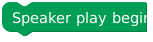
- Speaker.begin() bool
Start the Speaker function. Returns True if successful.
UIFLOW2:
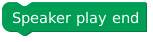
- Speaker.end() None
Disable the Speaker.
UIFLOW2:
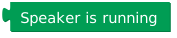
- Speaker.isRunning() bool
Check if the Speaker is running. Returns a boolean value.
UIFLOW2:
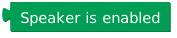
- Speaker.isEnabled() bool
Check if the Speaker is enabled. Returns a boolean value.
UIFLOW2:
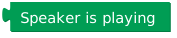
- Speaker.isPlaying([channel]) bool
Check if the Speaker is playing sound. Returns a boolean value.
If the parameter
channelis provided, it checks the playback status of the specified channel.channelaccepts values from 0 to 7.UIFLOW2:
- Speaker.getPlayingChannels() int
Get the number of channels currently playing.
UIFLOW2:

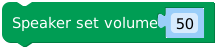
- Speaker.setVolume(volume: int) None
Set the master volume level for audio output.
volumeaccepts volume levels from 0 to 255.UIFLOW2:
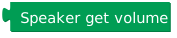
- Speaker.getVolume() int
Get the master volume level for audio output. Returns volume levels from 0 to 255.
UIFLOW2:
- Speaker.setVolumePercentage(percentage: float) None
Set the master volume level for audio output as a percentage.
percentageranges from 0% to 100%.UIFLOW2:
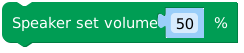
- Speaker.getVolumePercentage() float
Get the master volume level for audio output as a percentage. Returns volume levels from 0% to 100%.
UIFLOW2:

- Speaker.setAllChannelVolume(volume: int) None
Set the volume level for all virtual channels.
volumeaccepts volume levels from 0 to 255.UIFLOW2:

- Speaker.setChannelVolume(channel: int, volume: int) None
Set the volume level for a specific virtual channel.
Parameters:
volumeaccepts volume levels from 0 to 255.channelis the channel to play, ranging from 0 to 7.
UIFLOW2:

- Speaker.getChannelVolume(channel) int
Get the volume level for a specific virtual channel.
channelranges from 0 to 7.UIFLOW2:

- Speaker.stop([channel]) None
Stop sound output. If
channelis not specified, stop sound output for all channels.channelaccepts values from 0 to 7.UIFLOW2:
- Speaker.tone(frequency, duration[, channel[, stop_current_sound]]) None
Play a simple tone.
Parameters:
frequencyis the frequency of the tone in Hz.durationis the duration of the tone in milliseconds.channelis the channel to play, ranging from 0 to 7. By default, it is -1, which means using an available channel.stop_current_soundcontrols whether to wait for the previous audio playback to finish. If True, start the new output without waiting for the current output to finish.
UIFLOW2:

- Speaker.playRaw(wav_data: bytes|bytearray[, sample_rate: int[, stereo: bool[, repeat: int[, channel: int[, stop_current_sound: bool]]]]]) bool
Play PCM data.
Parameters:
wav_datais the buffer of audio data.sample_rateis the sample rate of the audio data.stereospecifies if the audio is stereo.repeatis the number of times to repeat the audio. Default is 1.channelis the channel to play, ranging from 0 to 7. By default, it is -1, which means using an available channel.stop_current_soundcontrols whether to wait for the previous audio playback to finish. If True, start the new output without waiting for the current output to finish.
UIFLOW2:

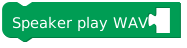
- Speaker.playWav(wav_data: bytes|bytearray[, repeat: int[, channel: int[, stop_current_sound: bool]]]) None
Play audio data in WAV format. Requires passing the raw data of the entire audio file.
Parameters:
wav_datais the buffer of audio data.repeatis the number of times to repeat the audio. Default is 1.channelis the channel to play, ranging from 0 to 7. By default, it is -1, which means using an available channel.stop_current_soundcontrols whether to wait for the previous audio playback to finish. If True, start the new output without waiting for the current output to finish.
UIFLOW2: